
TamOkuma Website: https://tamokuma.com/
With Türkiye's Common Written Exam System (OYSS), the open-ended mock exam has become one of the most direct diagnostic tools a school can turn to before the written exam. Apart from the 2 questions prepared by subject teacher groups, written exam questions now come from the question pool of the Ministry of National Education (MEB). Scores are entered into e-Okul question by question, and the aim is to analyse the results by learning outcome. By its nature, however, that analysis will come after the exam.
The strongest card a school holds is knowing, before the written exam, which student and which class is behind on which learning outcome. Below you will find the scope of OYSS, the 4-step preparation cycle, the 3 indicators to look for in the report, and the next step you can take with TamOkuma.
What Is an Open-Ended Mock Exam and Why Does It Matter in the Maarif Model?
An open-ended question is one where the student builds the answer in their own sentences instead of choosing it from options. An open-ended mock exam is a rehearsal and diagnostic exam held before the real written exam, in the same format, with questions mapped to learning outcomes.
In the Maarif Model era, written exams consist of open-ended questions. This requirement came with the 2023 legislation. The Ministry of National Education Measurement and Evaluation Regulation (Official Gazette, 9 September 2023, No. 32304) and the Written and Practical Exams Directive (11 October 2023) required written exams in lower and upper secondary schools to consist of open-ended questions, or of open-ended and short-answer questions. The Türkiye Century Maarif Model follows the same line with skill-based open-ended questions and formative assessment.
Two examples prepared by the author (not taken from the MEB pool):
- Grade 5 Turkish: “Evaluate the character's decision in the text with your own reasoning.”
- High school Turkish language and literature: “Explain the narrator's state of mind in the poem, citing two lines as evidence.”
What Is the Difference Between an Open-Ended and a Multiple-Choice Exam?
| Criterion | Multiple choice | Open-ended |
|---|---|---|
| Chance factor | A correct answer is possible by guessing | Guessing has very limited effect |
| Thinking process | Only the result is visible | Reasoning and justification are visible |
| Scoring load | Fast, automatic | Needs a rubric and time |
A geometry study by Sayın and Orbay (2024) found a high positive correlation between the two formats among 381 seventh-grade students (rs = 0.80). Yet the same students scored higher on the multiple-choice test. Because success in multiple choice does not carry over one-to-one to an open-ended written exam, a rehearsal of the format is needed.
The Common Written Exam System (OYSS) and a Strategy for Preparing
The Common Written Exam System (OYSS) was developed by MEB's General Directorate of Assessment, Evaluation and Examination Services. After a pilot held in the second term of the 2025-2026 school year at 1,999 schools in 11 provinces, the system came into use in the first written exams of the first term of the 2026-2027 school year (3-13 November 2026). The guide's two-question limit and question pool rules have been taken to the Council of State (Danıştay) by the Eğitim-İş and Türk Eğitim-Sen unions.
According to the OYSS application guide, scores are entered into e-Okul question by question, and the aim is to analyse the results by student, class and section against learning outcomes. Since this analysis comes after the exam, the goal in preparing for the common written exam should be to find learning-outcome gaps in advance, rather than to guess which question will come out of the pool. For the calendar, the subject teacher group's decisions and the steps for building an exam on EBA, see our OYSS guide.
Which Grades and Subjects Does OYSS Cover, and Who Writes the Questions?
| Topic | Scope |
|---|---|
| Lower secondary (grades 5, 6, 7) | Turkish, mathematics, science, social studies, religious culture and ethics, English |
| Upper secondary (grades 9, 10, 11) | Turkish language and literature, mathematics, physics, chemistry, biology, history, geography, religious culture and ethics, philosophy, English |
| Question source | In each written exam, subject teacher groups prepare 2 open-ended questions and their scoring key; the remaining questions are selected from the MEB question pool through OYSS on EBA. |
- Counted by school level, 16 subjects in total are in scope.
- English is out of scope in grades 7 and 11.
- The plan is to load about 8,000 skill-based open-ended questions into the pool before the first common exams, and to add about 8,000 new questions in every exam period after that.
Pool questions are opened to teachers only 4 days before the exam, which is too late for remediation. Which learning outcomes the exam will measure, however, is already known from the scenario the subject teacher group picks from the topic-question distribution table and announces to students in advance. So a school can know weeks ahead how ready students are on those outcomes. The breadth of the scope also means a separate open-ended mock exam is needed for each subject.
The Three Hard Parts of Open-Ended Written Exams: Questions, Scoring and Analysis
Writing the questions. Research on teacher views shows that teachers value open-ended written exam questions for measuring higher-order thinking skills. The difficulty starts with writing the question. Studies with Turkish language teachers show that they run into time and content-validity problems when preparing and scoring open-ended questions, and that the questions they write mostly stay at lower cognitive levels.
Scoring load and reliability. Take a worked example. A teacher who teaches 5 classes and asks 6 open-ended questions to 30 students in each reads 900 answers. At 1 minute per answer, that is about 15 hours of extra work. As fatigue and subjective judgement build up, the same answer can receive different scores. This is also where scoring reliability in open-ended exam assessment weakens.
Learning outcome analysis. Even when every paper has been read, one question remains open. Did the learning outcome drop in individual students, or across the whole class? To see this, every score has to be matched to its learning outcome and the classes compared. Done by hand, this assessment work often cannot be finished before the written exam.
Studies based on teacher views report that students unused to open-ended questions see their grades fall, and that students and parents view this question type negatively as a result. A mock exam is the safe way to go through this shock before the real written exam, with no risk to grades.
Preparing for OYSS with a Learning-Outcome-Based Mock Exam: A 4-Step Cycle
School-level preparation for the common written exams becomes clear once the learning-outcome-based mock exam is set within a four-step cycle: mock exam, standard scoring, learning outcome report and targeted remediation. The real written exam comes after this cycle.
1. Create an Open-Ended Mock Exam Mapped to Learning Outcomes for Each Subject
When preparing an open-ended mock exam by learning outcome, map each question to a single learning outcome. If a question spreads over more than one outcome, the report loses its meaning at outcome level. Limit the scope to the outcomes covered up to that written exam, and keep the question type close to the OYSS format. Holding the mock exam a few weeks before the real written exam leaves time for remediation; a window of three to six weeks is a reasonable start.
2. Score Answers in a Standard Way with a Rubric
An open-ended question scoring rubric defines in advance the criteria for full, partial and zero marks on each question. For results to be comparable, the same rubric has to be applied in the same way in every class and by every teacher.
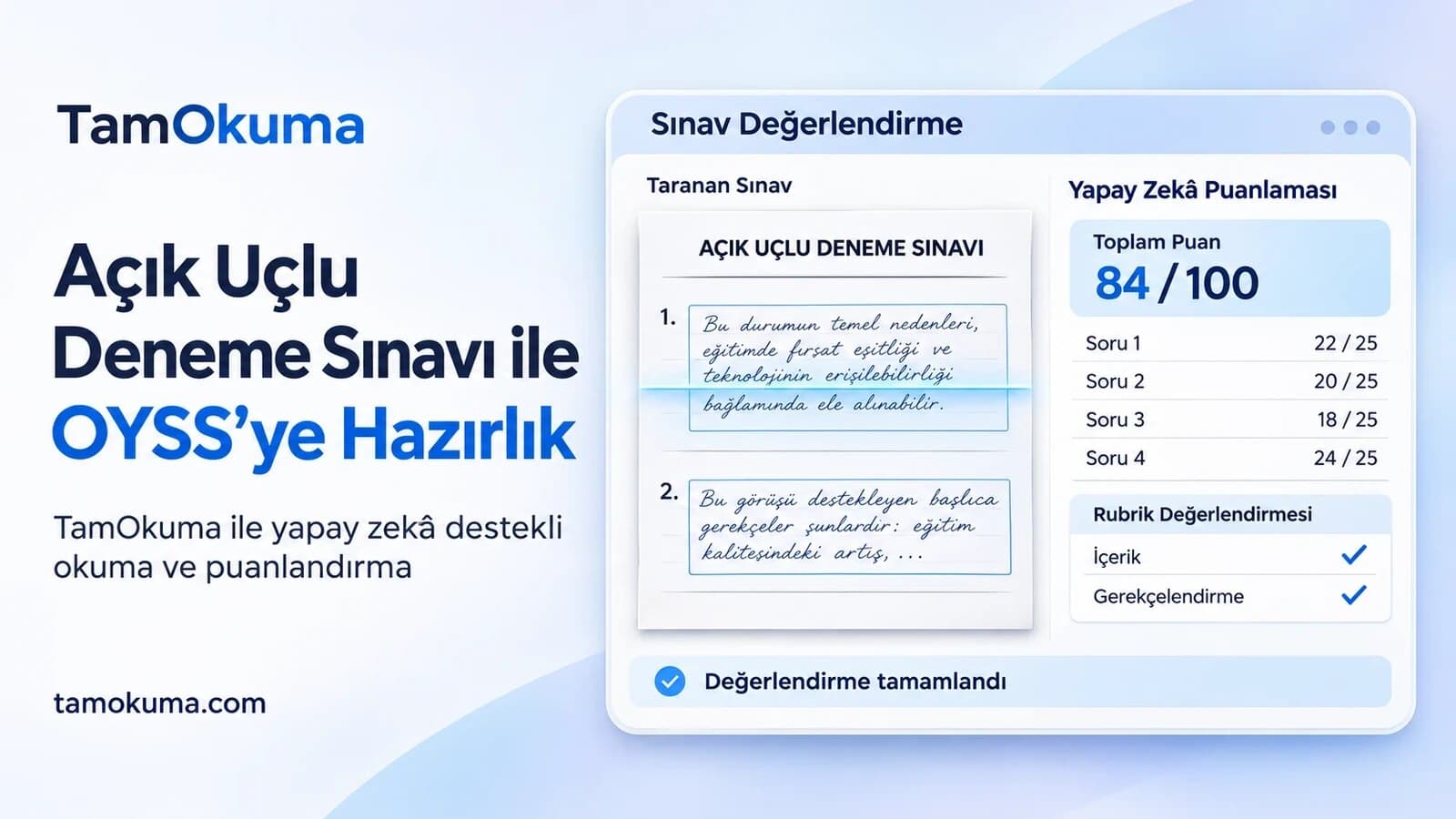
Exam papers can be read with AI through handwriting recognition (OCR) and rubric-based assessment. Because reading accuracy depends on the clarity of the handwriting and the quality of the scan, teacher approval is essential. According to the 2027 Presidential Annual Programme, published on 27 October 2026, MEB also plans to use AI to score open-ended questions in its school-based monitoring practice.
3. Read the Learning Outcome Analysis by Student and Class in the PDF Report
Learning outcome analysis after an open-ended exam starts with three indicators. The thresholds that separate them should be defined in advance according to the school's assessment approach.
- Incomplete learning outcome: an outcome the student has shown partially but not yet completed.
- Failed learning outcome: an outcome where the marks were largely not achieved.
- Learning outcome to develop: the list of outcomes prioritised for remediation.
Read the report at two levels. The student level is for the individual report card and parent meetings. When an outcome stays low across a whole class, the problem is most likely instructional; even so, the question itself should be reviewed. A learning outcome report like this offers, before the exam, a picture similar to the table OYSS aims to provide after it.
4. Go into the Real Written Exam with a Targeted Remediation Plan
- For an outcome that dropped across the class, reteach it in lessons.
- For an outcome that dropped in specific students, plan a study group or individual work.
- After remediation, measure progress with a short check question on the same outcomes or with a second mock exam.
The cycle starts again in every written exam period.
TamOkuma: One System from Open-Ended Mock Exam to PDF Learning Outcome Report
TamOkuma, developed by IndiviTech, brings the first three steps of this cycle together in a single system. The product supports preparing open-ended mock exams aligned with learning outcomes for each subject. According to the manufacturer's documentation, papers are read with handwriting recognition (OCR) and teacher-supervised AI. Answers are scored with the same criteria against the rubric set by the school, and the results become a PDF report by student, class and learning outcome.
| Cycle step | What TamOkuma does |
|---|---|
| 1. Mock exam | Creates a mock exam aligned with learning outcomes |
| 2. Scoring | AI-assisted assessment with a rubric |
| 3. Analysis | Learning outcome report by student and class (PDF) |
The fourth step, remediation, is the school's job; the report provides the data for that plan. Before deciding, reviewing a sample open-ended mock exam PDF report lets you see concretely what the system shows.
What Does the Report Show the Teacher, the School and the Student?
- For the school: the class report shows in which class an outcome dropped. Remediation resources go to the right class, and parent meetings rest on concrete data.
- For the teacher: it helps lighten the reading load from the 900-answer example, and a shared rubric gives more consistent scoring across classes.
- For the student and parent: the personal PDF report card shows the incomplete, failed and to-develop learning outcomes.
Frequently Asked Questions: AI Scoring and Student Preparation
How Should Students Prepare for an Open-Ended Mock Exam?
Students should prepare by turning the mock exam report into a study plan and by practising written answers. If you wish, you can prepare your written exam from the thousands of questions in TamOkuma. Three habits help when preparing for the common written exam:
- Turn the report into a plan: put the incomplete outcomes and the outcomes to develop from your personal report card into your weekly schedule.
- Write in full sentences: build your answer with reasoning and evidence, because the rubric also scores how you reached the result.
- Rehearse the timing: during the mock exam, try out how much time you will give each question.
A mock exam is held for diagnosis, not for a grade. A low mock exam score is data in your hands before the real written exam.
Manage the Preparation, Not the Question
Apart from the 2 questions prepared by the subject teacher group, the school no longer writes the exam questions. How ready students arrive for those questions, however, is still in the school's hands. The path runs through the mock exam, rubric scoring, the learning outcome report and targeted remediation.
The first written exams of the first term are held in November; the following written exam weeks are announced in the MEB work calendar. Starting a few weeks before the next written exam leaves real time for remediation. You can begin by looking at a sample report to see what a report for your classes would look like.
Plan your first open-ended mock exam with TamOkuma. To review a sample PDF learning outcome report or request a demo tailored to your school, visit the TamOkuma project site.
Sources
- Official Gazette of the Republic of Türkiye (9 September 2023, No. 32304). Ministry of National Education Measurement and Evaluation Regulation (in Turkish)
- Ministry of National Education (12 October 2023). Written and Practical Exams Directive Published (in Turkish)
- Ministry of National Education (October 2026). Common Written Exam System (OYSS) Application Guide (in Turkish)
- Demre District Directorate of National Education (3 November 2026). Statement from the Ministry of National Education: 2026-2027 Common Written Exam System (OYSS) Calendar Published (in Turkish)
- Ministry of National Education (10 September 2026). Nationwide Common Written Exam Calendar Announced (in Turkish)
- Sayın, V. and Orbay, K. (2024). Measurement Evaluation in Geometry: A Comparison of Multiple Choice and Open-Ended Exams. Third Sector Social Economic Review, 59(4), 2918-2931. doi:10.15659/3.sektor-sosyal-ekonomi.24.12.2564
- Cumhuriyet (2026). Lawsuit against MEB's common written exam system: Eğitim-İş applies to the Council of State (in Turkish)
- Haberler.com (2026). Türk Eğitim Sen sues at the Council of State to annul the two-question limit in the OYSS guide (in Turkish)
- Official Gazette of the Republic of Türkiye (27 October 2026, No. 33413, repeat issue). 2027 Presidential Annual Programme (in Turkish)
Want to learn more?
Get in touch with us to explore how IndiviTech can transform your education experience.
Contact us