
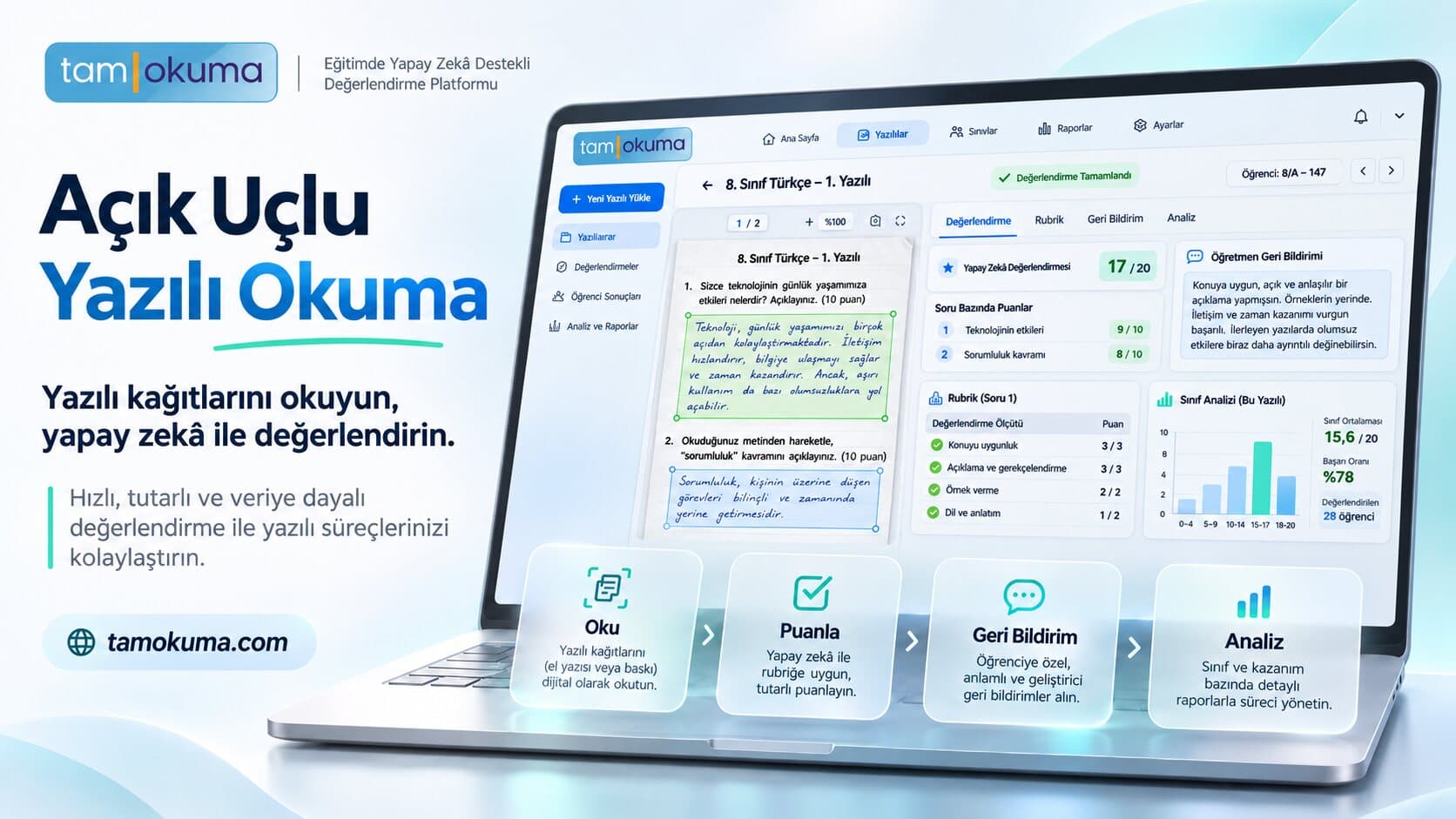
TamOkuma Website: https://tamokuma.com/
This guide looks at open-ended written exam grading software built for schools and teachers. With the Measurement and Evaluation Regulation published in Türkiye's Official Gazette (Resmî Gazete) No. 32304 on 9 September 2023, the Ministry of National Education (MEB) required that written exams set by middle and high schools consist of questions whose answers students construct themselves; the directive that followed based these exams on open-ended, or open-ended and short-answer, questions. The change also brought a heavy paper-grading workload for teachers and scoring differences between subject teams. Meanwhile, according to a 2025 study by Gallup and the Walton Family Foundation, US teachers who use AI tools at least weekly estimate that they save 5.9 hours a week on average. By combining rubric creation with AI-assisted grading of exam papers, TamOkuma gives schools a standardized, fast and reliable assessment experience.
Why Does the Open-Ended Exam Era Need a New Kind of Exam Grading Software?
Since MEB's Measurement and Evaluation Regulation and its Written and Practical Exams Directive of 11 October 2023 came into force, school-wide common written exams in Turkish middle and high schools have consisted of open-ended, or open-ended and short-answer, questions. Since the 2024-2025 school year, nationwide common exams have also been held without multiple-choice questions, using open-ended and short-answer questions. From a teaching point of view, this is the right call: open-ended questions reveal not whether students have memorized information, but what they think, how they think and how they build an argument.
But there is another side to the coin: during exam weeks, grading hundreds of papers by hand, one by one, creates a serious operational crisis for teacher workload.
In a scenario common in the field, traditional grading both eats up teachers' time and undermines the reliability of assessment. Different teachers giving the same answer different scores is an unavoidable problem too. Using a new kind of open-ended exam grading software to achieve scoring consistency across a school and to free teachers from piles of paper is no longer a choice but an institutional need.
How Is Written Exam Grading Software Different From a Traditional Optical Mark Reader?
So why do the optical readers we have used for years fall short in this new era? Traditional optical mark readers only detect the filled-in bubbles on multiple-choice tests (A-B-C-D-E); on open-ended exams they are useless. AI-assisted exam grading software such as TamOkuma, by contrast, uses advanced handwriting recognition (OCR) and natural language processing. It reads the open-ended answers and solution steps that students write in their own words, and analyzes every answer against the same criteria in the rubric the school has set.
What Is TamOkuma? An End-to-End Solution From Rubric to Report
This technological shift, which leaves traditional optical readers behind, does not end with reading exam papers. It runs the whole assessment process as one, from preparing the rubric to producing report cards. Developed by IndiviTech from its experience with schools, TamOkuma is a complete written exam grading and assessment platform that meets this need of educational institutions.
The platform manages the entire process end to end, from uploading the written exam to rubric-based AI grading and detailed report cards. This comprehensive structure gives institutions looking for a written assessment system for schools a standardized, transparent and reliable workflow that keeps the margin of error to a minimum.
How Do You Prepare a Rubric Aligned With Learning Outcomes in TamOkuma?
One of the tasks that cost teachers the most time during exam periods is preparing a scoring key for every open-ended question. TamOkuma lightens this load too: when you upload your written exam, the questions are automatically extracted and matched to the curriculum, and the AI suggests a rubric (analytic scoring key) aligned with the learning outcomes for each question. The teacher approves the suggestion or uploads their own rubric. This way, subject teams agree on how many points each step of a solution earns before any paper is graded, and share a common standard.
How Are Open-Ended Exam Papers Graded With AI?
The rubrics are ready, but what about grading the papers? The assessment is completed quickly without disrupting teachers' existing habits. The answered exam papers are scanned or photographed and uploaded to the platform in bulk. TamOkuma's AI engine reads students' handwriting, written responses and mathematical steps on the papers with high accuracy. It then analyzes each answer against the rubric criteria set before the exam and scores it. As a result, hundreds of papers are assessed against the same objective criteria.
How Does AI-Assisted Exam Grading Software Work? (TamOkuma in 4 Steps)
Behind this assessment and reporting architecture is a practical structure that fits easily into schools' existing exam routines. As AI-powered grading software for open-ended written exams, TamOkuma completes the process in four basic steps, with no extra technical setup:
- Uploading the exam and the rubric: The teacher or head of department uploads the written exam; the questions are automatically extracted and matched to the curriculum. The rubric the AI suggests based on the learning outcomes is approved, or the school uploads its own.
- Administering the exam and scanning the papers: The exam is taken in class on printed paper, as usual. The collected papers are scanned with the school's scanners or photographed, then uploaded to the system in bulk by class; papers are matched to students automatically.
- Rubric-based assessment with AI: Advanced handwriting recognition (OCR) converts students' answers into digital text. The AI exam grading engine matches each answer to the defined criteria, carries out rubric-based exam assessment and scores the papers.
- Teacher review and approval: Once automated grading is complete, the scores suggested by the AI appear on the teacher's screen together with the reasoning for each criterion. The teacher reviews the results, revises scores where needed and produces the analysis reports from the approved results.
The Concrete Benefits of TamOkuma for Schools and Teachers
This four-step process, completed with the teacher's approval, transforms the culture of assessment in schools. Built as an AI-assisted written assessment platform for schools, TamOkuma is designed not to replace teachers, but to free them from the drudgery of grading papers so they can focus on teaching and guidance.
How Does Rubric-Based Written Assessment Save Teachers Time?
According to the joint study Gallup and the Walton Family Foundation published in 2025, 79% of teachers who use AI for grading and feedback at least monthly say these tools save them time. Reading open-ended exam papers line by line is one of the heaviest burdens eating into educators' evenings. In the same study, teachers who use these tools at least weekly estimate that they save 5.9 hours a week on average, the equivalent of about six weeks a school year. In an exploratory survey of 336 US educators carried out in August 2025 by Youngstown State University's (YSU) online education programs, 52% of teachers say AI tools reduce burnout and save time. And in a YouGov survey of 1,033 UK teachers for Bett in June 2026, 51% of teachers who use AI say it has eased their workload, although only 35% say they are working fewer hours.
Teachers say they spend this time, which the Gallup and Walton Family Foundation report calls the "AI dividend", on giving students more detailed feedback, preparing individualized lessons and communicating with parents. Stephanie Marken, senior partner for U.S. research at Gallup, sums up the shift: "Teachers are not only gaining back valuable time, they are also reporting that AI is helping to strengthen the quality of their work."
How Does AI Grading Affect Scoring Reliability and Standardization?
Saving time matters, but a fair and consistent assessment is just as critical. Score differences between teachers in the same subject team, or between the first and last paper graded by the same teacher, are common in practice and are the biggest challenge in open-ended exams. In a master's thesis completed in 2025 at Ankara University's Institute of Educational Sciences (Şener, 2025), the open-ended common math exam papers of 217 seventh-grade students from five campuses of a private school were scored both by teachers and by an AI system. The Cronbach's alpha reliability coefficient of the AI scoring was higher than that of the teachers' scoring, and the item-total correlations and discrimination indices also pointed to the AI being more consistent. That said, both assessments were found to be highly reliable.
Of course, the same study found that agreement between teacher and AI scores was high for algorithmic operations and applying formulas, but low for questions requiring conceptual understanding and multi-step problem solving; in other words, human and machine assessment can diverge on such questions. Likewise, in the Gallup and Walton Family Foundation study, 14% of teachers who use AI for grading and feedback say the quality of this work has slightly decreased. That is why a "teacher-supervised AI" approach is the basis for ensuring scoring consistency.
The teacher always has the final say. TamOkuma scores every answer consistently against the school's rubric, but always leaves the final decision and the authority to revise scores to the teacher's expertise.
Detailed Exam Reports by Student, Class and Learning Outcome
In traditional exam grading, only a total score is written on the paper, and how well a student has mastered each learning outcome often remains unclear. The natural result of a standardized and reliable scoring process, however, is high-quality educational data that guides schools. TamOkuma turns assessment into a comprehensive analysis of open-ended written exams under MEB rules, converting the results of graded papers into analyses by student, class, question and learning outcome, and into detailed PDF report cards that can be shared with parents and students.
Thanks to the resulting outcome-based exam reports and detailed item and outcome analysis, assessment units and heads of department can quickly see which topics are lagging in which class. According to the Gallup and Walton Family Foundation study, 57% of teachers who use AI for grading and feedback say the quality of the grades and feedback they give has improved.
Open-ended written exams are essential for measuring students' real thinking skills. Still, the process should not leave teachers spending hours buried in piles of paper. With rubric-based scoring and AI-assisted reading, TamOkuma helps schools build a standardized, fair, fast and data-driven culture of assessment. To standardize open-ended exam grading at your school with AI, save your teachers time and try outcome-based assessment reports, fill in the "Demo Talebi" (demo request) form at TamOkuma.com to request a free demo tailored to your institution.
Sources
- Official Gazette of the Republic of Türkiye (9 September 2023, No. 32304). Ministry of National Education Measurement and Evaluation Regulation (in Turkish)
- Ministry of National Education (12 October 2023). Written and Practical Exams Directive Published (in Turkish)
- Ministry of National Education (1 November 2024). Nationwide Common Exam Questions and Answers Published (in Turkish)
- Gallup (24 June 2025). Three in 10 Teachers Use AI Weekly, Saving Six Weeks a Year
- Walton Family Foundation (25 June 2025). The AI Dividend: New Survey Shows AI Is Helping Teachers Reclaim Valuable Time
- Youngstown State University Online. Teachers and AI: A Study on Confidence Gaps and Challenges
- Bett (2026). The state of AI in education 2026
- Tes (27 August 2026). Teachers' use of AI soars – but has little impact on working hours
- Şener, S. S. (2025). A comparison of artificial intelligence and teacher scoring in the assessment of open-ended mathematics questions (Master's thesis, Thesis No. 955051, in Turkish). Ankara University, Institute of Educational Sciences. Council of Higher Education National Thesis Center
Want to learn more?
Get in touch with us to explore how IndiviTech can transform your education experience.
Contact us