
Here is what keeps happening in practice: a teacher looking for information about the Common Written Exam System shuttles back and forth between short introductory videos, provincial announcements and a long implementation guide. And as the first common written exam period approaches, the question on everyone's mind is always the same: how much room does OYSS leave the teacher?
The system does not take the written exam out of the teacher's hands.
What changes is the work itself. Writing questions from scratch gives way to a workflow built on choosing a scenario, editing the pool, marking with a scoring key and reading reports. In this guide you will first find the scope table, the calendar, the decision map and the login steps. Then come the open-ended exam and the scoring process, the post-exam steps, the points under debate and the frequently asked questions.
What Is OYSS? The Purpose of the Common Written Exam System
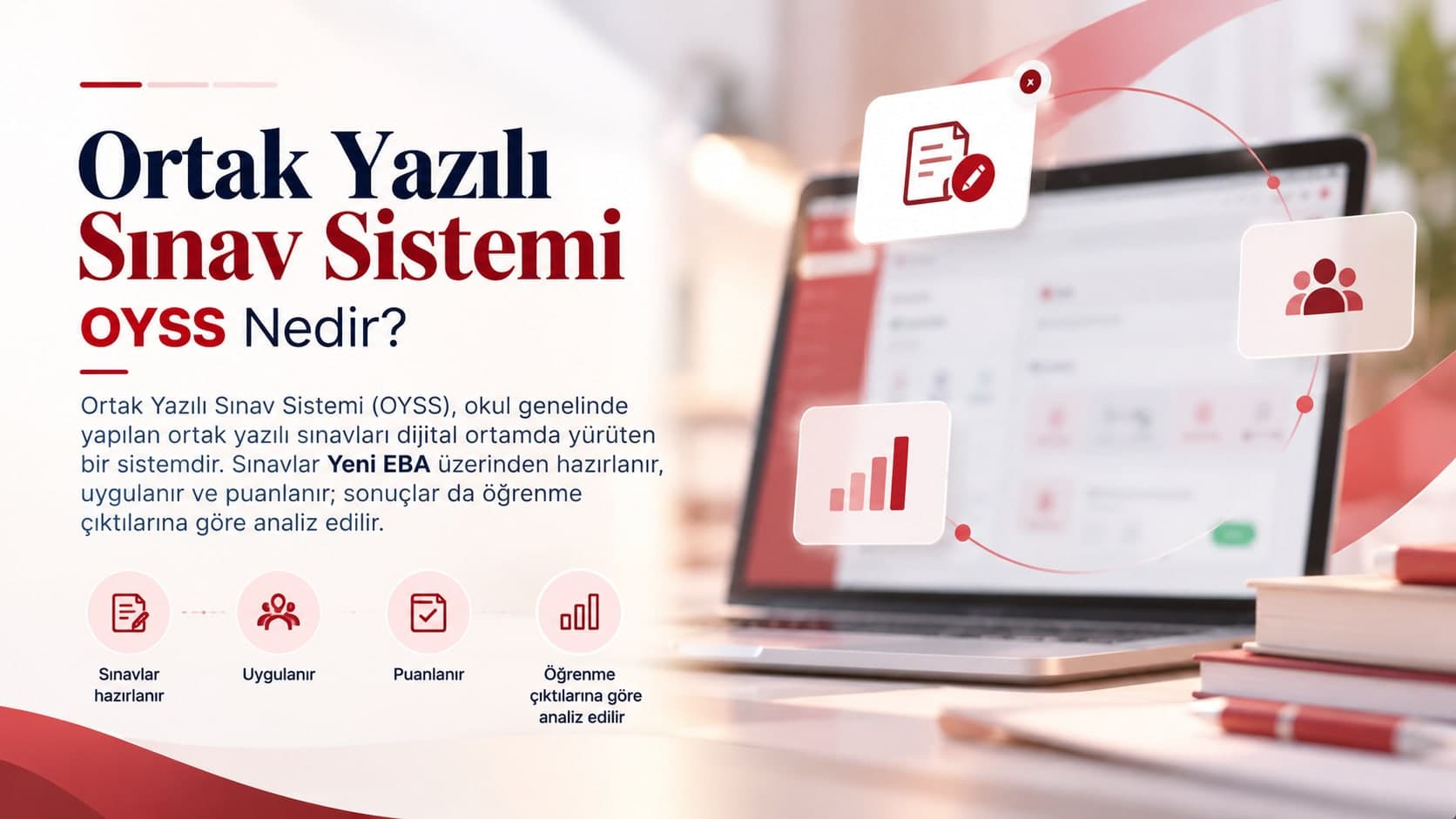
What is OYSS? The Common Written Exam System (OYSS) is a system that runs school-wide common written exams digitally. Exams are prepared, administered and scored through Yeni EBA (the ministry's e-learning platform), and the results are analyzed against learning outcomes. The system was developed by ODSGM, the Directorate General for Assessment, Evaluation and Examination Services of MEB (the Ministry of National Education).
So what is the aim? Three goals stand out in OYSS, also referred to as the new MEB exam system: wider use of open-ended, skills-based questions in schools, a shared assessment standard across schools, and results that are analyzed at student, class (şube) and school level and turned into evidence-based feedback.
According to Deputy Minister of National Education Ömer Faruk Yelkenci, assessment and evaluation is no longer something carried out at the end of education but "a process that develops our students and our teachers".
Which Grades, Subjects and Schools Does OYSS Apply To?
Is your school in or out? The table and the list of exceptions below answer that question.
The 16 Subjects in Scope: Middle School and High School Table
| Level | Grades | Subjects |
|---|---|---|
| Middle school | 5, 6, 7 | Turkish, mathematics, science, social studies, religious culture and ethics, English |
| High school | 9, 10, 11 | Turkish language and literature, mathematics, physics, chemistry, biology, history, geography, religious culture and ethics, philosophy, English |
MEB's common exam scheme covers these 16 subjects in both state and private schools. Under the provisions of the Implementation Guide, the rule for elective subjects is different: electives that appear in the ministry's topic-question distribution tables go into the system, while the exam for those not in the tables is prepared by the subject zümre (the school's subject department) itself. In Turkish, Turkish language and literature, and English, only reading and writing exams are held through OYSS. You will find where listening and speaking exams stand in the FAQ section.
Grades, Subjects and School Types Outside the Scope
For those asking "which schools will OYSS not apply in?", the list of exceptions set out in the guide is as follows:
- International private education institutions
- Evening high schools and vocational training centers
- Special education vocational and practice schools (levels I, II and III) and the special education classes that run these programs
- Grade 7 and grade 11 English lessons
- The religious culture and ethics lesson in minority schools
- All subjects in preparatory classes
- Foreign language exams in the middle school multiple foreign language program
- The foreign-national student classes of international Anatolian imam hatip high schools
Grades 8 and 12 are not on the 2026-2027 scope list. In vocational schools running an intensified education program, the scheme is limited to grade 9 only.
Are private schools in scope? Yes. Private schools running a ministry-approved institution-specific program are in scope too, because those programs have to meet the learning outcomes of the official curriculum.
Tutoring centers and cram schools, on the other hand, do not administer OYSS. Their real contribution is preparing students for the logic of an open-ended exam.
The 2026-2027 Common Written Exam Calendar
If you have settled the question of scope, the next step is to write the common written exam calendar into your zümre plan.
| Stage | Date |
|---|---|
| Teacher briefings and training | 19-23 October 2026 |
| Trial runs and the opening of the system for use | 26 October 2026 |
| First term, first common written exams | 3-13 November 2026 |
| Make-up exams | 23-27 November 2026 |
The system was introduced on 16 October 2026, and the OYSS implementation guide was published on 20 October 2026. For the common written exam dates of the later written exam periods of 2026-2027, you need to follow the announcements of MEB and the provincial directorates of national education. Teachers who need additional training can apply to their provincial assessment and evaluation center directorate.
Decision Map: What Do the Ministry, the Zümre and the School Administration Decide in OYSS?
"Are the written exams now prepared by the ministry?" No.
The ministry sets the framework; the subject zümre teachers shape the exam. The table below shows who decides what at a glance:
| Stage | Decision-maker | Note |
|---|---|---|
| Scope, topic-question distribution tables, scenarios | The ministry (ODSGM) | Determined centrally |
| Scenario selection | Subject zümre teachers | School type and students' level of learning are taken into account |
| The central question pool | The ministry | Contains questions at easy, medium and hard levels |
| Replacing 2 questions from the pool, writing 2 questions with a scoring key | The zümre | Details in the open-ended exam section |
| Difficulty level and point values | The zümre | According to the scenario chosen |
| Entering the data into the system | The zümre head | Preparation is the zümre's shared work |
| The MEBBİS Zümre Modülü record (the ministry information system's subject-department module), teacher excused-absence details | The school administration | A precondition for access |
| Planning the make-up exams | The school administration | The exam is held through OYSS |
A shared OYSS question pool does not mean that every school will administer the same exam. Schools on double-shift schooling can even create different exams for their morning and afternoon classes. If a scenario cannot be applied in the lesson of a teacher who has been away from duty for a long time, the subject zümre prepares the exam. In ODSGM's words: "teachers' decisive role continues".
OYSS Login: Steps for Creating an Exam Through EBA
As the map makes clear, the authority to enter the exam into the system rests with the zümre head. And the first condition is that the assignment record in MEBBİS is complete.
OYSS Login and Exam Creation, Step by Step
- The school administration enters the zümre head assignment into the MEBBİS Zümre Modülü in full.
- The zümre head logs in to Yeni EBA with an EBA, MEBBİS or e-Devlet (the national e-government gateway) password.
- The OYSS module inside EBA opens. If the module is not visible, move on to the checklist below.
- The zümre selects the appropriate scenario, taking into account the criteria in the decision map.
- The questions coming from the pool are reviewed; if necessary 2 questions are replaced, and then the difficulty level and the point values are set.
- The 2 open-ended questions prepared by the zümre are added to the system together with their scoring keys, and the exam is complete.
If the Module Is Not Visible: The MEBBİS Zümre Modülü Checklist
Check these:
- Is your appointment as zümre head recorded in the MEBBİS Zümre Modülü?
- Are your assignment and user details up to date?
- Has your EBA user record been completed?
As far as we have observed in practice, most access problems come from incomplete records in the MEBBİS Zümre Modülü. If a record is incomplete, have the school administration correct it and try your EBA OYSS access again. Still no luck? Ask for technical support from the provincial or district directorate of national education through the school administration. If the login problem is holding up your preparation, the system can also be accessed with school administrator authorization; keep that option in mind when time gets tight.
The Open-Ended Exam: How Are Questions Prepared and Scored in OYSS?
At its core OYSS is an open-ended exam model. Every question in the system is built as open-ended and on skills-based question logic; the questions added at the last link of the login steps reflect the same approach to assessment.
How Many Questions Are in an OYSS Exam, and How Many Does the Teacher Write?
6-8 on average. That is the range for the number of open-ended questions a student faces in one exam. The zümre itself prepares 2 questions addressing the learning outcomes of the chosen scenario, together with their scoring keys. The remaining questions come from the OYSS question pool, and 2 of those can be replaced.
According to the target announced in the press, roughly 8,000 questions will be transferred into the pool in the first stage, and roughly 8,000 new questions will be added each exam period. However big the pool grows, the skill of writing open-ended questions remains the zümre's most decisive contribution to the exam. Schools that teach mathematics and science in a foreign language can, by zümre decision, translate the questions into the language of instruction.
What Separates an Open-Ended Question from a Multiple-Choice One? Preparation Tips for Students
The difference starts with the options. An open-ended question has no choices; the student writes the solution and the reasoning behind it in their own words. The scoring key makes it possible to award points separately for the correct parts of an answer. With this graded scoring logic, even an unfinished solution does not go to waste.
The suggestions below are not an official OYSS rule; they are general preparation principles for students, parents and tutoring centers:
- Justify your answer and show the working steps without skipping any.
- Read the task verb in the question (explain, compare, and so on) carefully.
- Keep your answer within the scope the question asks for.
And a word of warning: do not trust unofficial websites that claim to offer the official pool under the name "OYSS questions".
After the Exam: e-Okul Score Entry, Analysis Reports and the Sharing Rule
The work does not end when the exam ends; this is exactly where the data and analysis stage of OYSS begins. The basic rule for OYSS score entry in e-Okul (the ministry's student records system) is this: every answer is marked against the scoring key, and the points are transferred to e-Okul question by question. For inclusion and mainstreaming students covered by a BEP (individualised education program), question-level scoring is not used; only the total score is entered into the system.
What comes out of this data? The system produces learning-outcome-based analysis reports at student, class and school level. The evidence-based feedback listed among the aims becomes concrete at this stage. By automating with OYSS the exam analysis that regulations already make compulsory, MEB aims to reduce the teacher's reporting burden.
Once the results are announced, the questions and the answer key can be reviewed in class together with the students. Caution: taking the questions and the answer keys outside the school, or sharing them on the internet or on social media, is prohibited.
Criticisms Directed at OYSS and the Points Under Debate
Workload is a topic of its own. Even though MEB says it aims to reduce the reporting burden, criticism of the OYSS teacher workload comes to a head over question-level scoring. Maarif Platformu (a teachers' association) sees open-ended questions as a positive goal; at the same time, it asks that the burden e-Okul entry will create in crowded schools, and the accessibility needs of teachers with disabilities, be taken into account.
On the artificial intelligence front, the uncertainty continues. No official timetable has yet been announced for the planned AI-assisted scoring.
Weighing the system's contribution to assessment and evaluation will require seeing the first term in practice.
Frequently Asked Questions About the Common Written Exam System
Are the common written exams in grades 8 and 12 held through OYSS?
The 2026-2027 scope list covers grades 5-7 in middle school and grades 9-11 in high school; grades 8 and 12 are not on that list. For possible changes, it is worth following MEB's announcements about OYSS.
Are the Turkish and English listening and speaking exams included in OYSS?
No. In Turkish, Turkish language and literature, and English, OYSS covers only the written exams addressing reading and writing skills. The listening and speaking exam is run by the subject zümre in line with the relevant regulations.
How is the make-up exam prepared?
Students with a valid excuse sit the make-up exam through OYSS between 23-27 November 2026. The exam is built on the basis of the scenario chosen for the main exam: the zümre writes 2 of the questions and the rest come from the pool.
Are separate exams held for each program in multi-program high schools?
No. In schools running more than one program, a separate exam is not prepared per program; a single common written exam is administered for each subject and grade level within the scope of OYSS.
The division of labor is actually plain. In OYSS the ministry sets the scope and the calendar, while scenario selection, question editing, difficulty level and scoring decisions stay with the zümre. A teacher who knows that distinction uses the system not as a burden but as a means of control.
The to-do list is short too: check your MEBBİS record now, write the 3-13 November calendar into your zümre plan, and share the logic of the scoring key with your students. And do not lose sight of the official announcements, given the changes that may be made to the guide and the legal proceedings. You can share the decision map and the MEBBİS checklist from this guide with your colleagues as a quick reference for your zümre meetings, and carry the open-ended exam preparation principles for your students over to your classroom information boards.
Want to learn more?
Get in touch with us to explore how IndiviTech can transform your education experience.
Contact us