Exams & Assessment

Optical Mark Reading

An exam ends, the sheets go through the scanner the school already owns or a phone camera, and the ranking list is out the same day. Mock exams, shared term exams and the short tests run at weekend courses all follow…
indivitech.com / services / optical-mark-reading
Optical Mark Reading

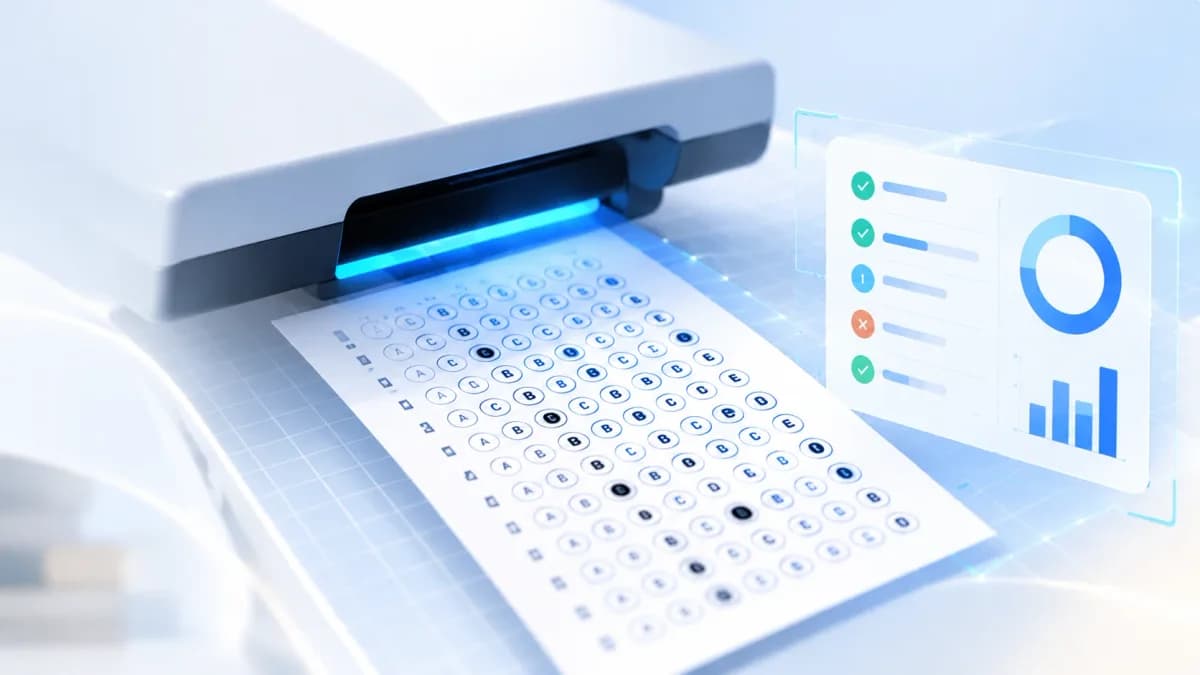
An exam ends, the sheets go through the scanner the school already owns or a phone camera, and the ranking list is out the same day. Mock exams, shared term exams and the short tests run at weekend courses all follow the same path, and neither the papers nor the results leave the building for an outside reading service. We designed it around exam day as the people who run it experience it: the assessment team, the teacher responsible for the paper, and the administrator who has to publish the result.

The answer key is defined once for each booklet variant, and if a question is withdrawn or a weighting changes, every paper is rescored. Gone are the overlay held against each sheet, the scores typed into a spreadsheet and the class lists reordered by hand; sheets that went through the scanner crooked are corrected as they are read. Results can go out while students still remember the questions: report cards print, parents get their notification, and the department meeting opens with figures per outcome rather than impressions. Because every sitting stays in the archive, comparing classes does not have to wait for the end of term.

Features
  • Answer sheets read with a phone camera
  • Skewed and damaged sheets corrected during scanning
  • Separate answer keys for booklets A, B, C and D
  • Re-scoring when a question is voided or weights change
  • Correct, wrong and net analysis by outcome and topic
  • Printable report cards and WhatsApp result alerts to parents
Contact us

Let's bring your project to life.

Tell us your needs and we'll map out a plan tailored to you.
Related services

Book and Question Quality Review
Exams & Assessment

Book and Question Quality Review

Book and Question Quality Review checks questions and book typesetting against defined criteria and reports every issue with its reason. It runs at two levels: the question review examines items one by one, while the book review adds the typesetting and question layout on top of the same checks. A shifted answer key or a question set twice cannot be fixed once the file has gone to print. The work belongs to the editors, typesetters and publishing coordinators doing the final read on a tight schedule. Criteria are held as named headings such as factual accuracy, curriculum fit, single correct answer and language use, and a publisher can add its own rules as new headings later. The report shows each question's image beside the headings it fails and why; formal checks such as option order and duplicate items sit in the same place. The book-level review adds question numbering continuity, items broken across pages and answer-key consistency. What you keep is a correction list that can be worked through heading by heading before the print run.

View details
AI-Powered Assessment
Exams & Assessment

AI-Powered Assessment

Scoring the papers is not where the work ends: item difficulty, discrimination and distractor analysis measure the exam itself, not only the students. In most institutions the process closes when the sheets are scanned and the report cards go home, leaving the question of whether an item measured anything, or just confused everyone, to staffroom opinion. This is written for the people who set the paper and then have to explain the result to a parent: the assessment office, department heads and academic coordinators. It fits inside the exam calendar you already run — your department still writes the paper, the sheets are still scanned, and the difference begins once reading is done. A department meeting then opens with a list of items to retire and outcomes to teach again, instead of an argument about which questions felt hard. The same data tracks progress by outcome through the term, puts a predicted LGS or YKS score and percentile band beside a student's mock results, and gives the guidance team a table to open in a parent meeting. Next term's exam plan is then built from those tables rather than from memory.

View details
Digital Publishing
Content & Digital Publishing

Digital Publishing

Digital Publishing turns the printed books of publishers and schools into an interactive digital edition built for teaching in front of a class. Most school conversations now open with a question about the digital edition, and projecting the print-ready file onto the board is not an answer to it. The service is for publishers who would rather not build an in-house digital team, institutions that publish under their own name, and schools that plan their lessons around the board. Production starts from the same typeset files that go to the printer, so page order, numbering and layout stay identical to the printed copy: when a teacher says page 92, the page on the board is page 92. Interactive material is layered on top of those pages afterwards, so a new video or activity never waits for the next print run. The same book opens on web, Windows, Pardus, iOS and Android, and the offline package for classrooms with no connection is built from that same source. The institution ends up with a digital catalogue under its own brand that stays current through the term, keeping the editorial decisions while we carry the technical side.

View details