
TamOkuma Website: https://tamokuma.com/
This guide is about reading and scoring the open-ended written exam papers that middle schools and high schools prepare in line with the Türkiye Yüzyılı Maarif Modeli (TYMM), Türkiye's national curriculum model.
A small calculation shows the scale of the workload. A teacher who asks 6 open-ended questions to 30 students in each of five classes ends up with 900 answers to mark against a rubric. Even at one minute per answer, that is roughly 15 hours of extra work. And as fatigue builds, so does the risk of giving the same answer two different scores.
TamOkuma, developed by IndiviTech, was designed to lighten that load with handwriting recognition (OCR) and teacher-supervised AI. Below we walk through the process, starting with the regulation and ending with a four-step implementation.
How Does Written Exam Marking Work Under the Türkiye Yüzyılı Maarif Modeli?
The open-ended exam requirement actually predates the Maarif Model. The Assessment and Evaluation Regulation, published in the Official Gazette on 9 September 2023 under number 32304, and the Directive on Written and Practical Exams dated 11 October 2023 require written exams in middle and high schools to consist of open-ended, or open-ended and short-answer, questions. In a MEB announcement from March 2024, Kemal Bülbül, then Director General for Assessment, Evaluation and Examination Services, tied the rationale for the shift to the goal of "better measurement".
The Türkiye Yüzyılı Maarif Modeli assessment and evaluation approach widens that foundation with a focus on skills and process. According to Deputy Minister of National Education Ömer Faruk Yelkenci, the ministry treats assessment and evaluation as "a process that develops our students and our teachers".
With the common written exam system (OYSS) introduced in the 2026-2027 academic year, MEB aims to broaden formative assessment practice, increase the use of skills-based open-ended questions and establish a measurement standard across schools. As our OYSS guide sets out in detail, the system covers grades 5, 6 and 7 in middle school and grades 9, 10 and 11 in high school, across 16 subjects in total.
Optical mark reading systems, which only read the option a student has shaded, cannot see how that student reasoned. Under the MEB approach to open-ended exam assessment, every paper is examined criterion by criterion. That labour-intensive process is what we mean by Maarif Model written exam marking.
What Are Learning Outcomes, Process Components and Assessment Scales in the Maarif Model?
According to the official TYMM portal, the model integrates conceptual skills, field skills, social-emotional learning skills and literacy skills with learning outcomes. A learning outcome describes what a student should be able to do; process components describe the intermediate steps that lead there. An assessment scale, in turn, is a tool that ties those steps to predefined criteria — a rubric, for example.
As our Maarif Model question bank review reports, as of October 2026 the portal lists 324 textbooks and 72 teaching materials. While the materials are being renewed around skills, written exams are likewise expected to measure not only the final answer but the steps of thinking behind it.
Why Is a Rubric (Scoring Guide) Necessary in MEB Open-Ended Written Exams?
Would two teachers give the same answer the same score on an open-ended question? Without a clear key in hand, perhaps not. A rubric reduces that uncertainty by tying partial credit to predefined criteria and performance levels. It makes measurement comparable across classes and makes visible which process component a student is stuck on.
What Is TamOkuma? Meet the Maarif Model Open-Ended Exam Marking Software
Part of the IndiviTech education technology ecosystem, TamOkuma is open-ended exam marking software built for Maarif Model written exam marking. As described on its product page, it reads printed papers using AI and handwriting recognition. It scores every answer against the rubric using the same criteria, and turns the results into reports at student, class, learning outcome and institution level.
An average of 5.9 hours a week. In the June 2025 US study by Gallup and the Walton Family Foundation, teachers who use AI tools at least weekly estimate they save that much time — the equivalent of about six weeks of work over a school year. According to the same research, 79% of teachers who use AI for grading and feedback at least monthly say these tools save them time.
One limitation is worth noting: this data is self-reported by teachers, it measures workload rather than student achievement, and it is not specific to TamOkuma.
How Does TamOkuma Turn Handwritten Exam Papers into Digital Text?
The first link in the AI-assisted exam marking chain is converting the handwriting on the paper into text. This step requires no additional technical setup at the school: the handwriting recognition (OCR) layer transfers the answers on scanned or photographed papers into digital text. Where a passage cannot be read, the system does not guess; it flags that passage, keeps the original image of the paper on screen and leaves the decision to the teacher.
Can a Teacher Change the Score in AI-Assisted Open-Ended Exam Marking?
Yes. TamOkuma's teacher-supervised scoring approach is summarised on the service page in a single principle: the system proposes a score for each criterion and shows its reasoning, but "the teacher always has the last word". The breakdown and partial score for every criterion are visible on screen; the teacher approves or changes the proposed score, and the change is reflected in the report immediately.
Why does that authority matter? In a master's thesis completed in 2025 at Ankara University's Institute of Educational Sciences (Şener, 2025), the open-ended common math exam of 217 seventh-grade students across five campuses of a private school was scored both by teachers and by an AI system. The AI scoring proved more consistent in terms of Cronbach's alpha, item-total correlations and discrimination indices. On questions requiring deep conceptual understanding and multi-step problem solving, however, human and machine scores could diverge.
In the Gallup-Walton research, 14% of teachers who use AI for grading also say the quality of assessment has dropped somewhat. Consistency and accuracy are not the same thing; a system can give the same score every time and still be wrong. That is why teacher approval is not a formality but the real safeguard in the process.
How Is Maarif Model Written Exam Marking Done with TamOkuma? (4 Steps)
TamOkuma's answer to the question "how are Maarif Model open-ended written exam papers marked?" consists of four steps.
1. Defining the Exam, the Rubric and the Learning Outcomes in the System
First you upload the exam questions and the criteria of your scoring guide (rubric) to the platform. Each open-ended question is matched to the learning outcomes and objectives on the Türkiye Yüzyılı Maarif Modeli curriculum map. The assessment criteria are therefore settled before the exam is even held.
2. Scanning and Uploading Printed Papers with Automatic Matching
Your classroom routine does not change on exam day; students answer the questions with pen and paper as always. When the exam is over, you scan or photograph the papers and upload them in bulk. Because the software matches each paper to the relevant student automatically, manual sorting is largely eliminated.
3. Rubric-Scaled Partial Scoring with OCR and AI
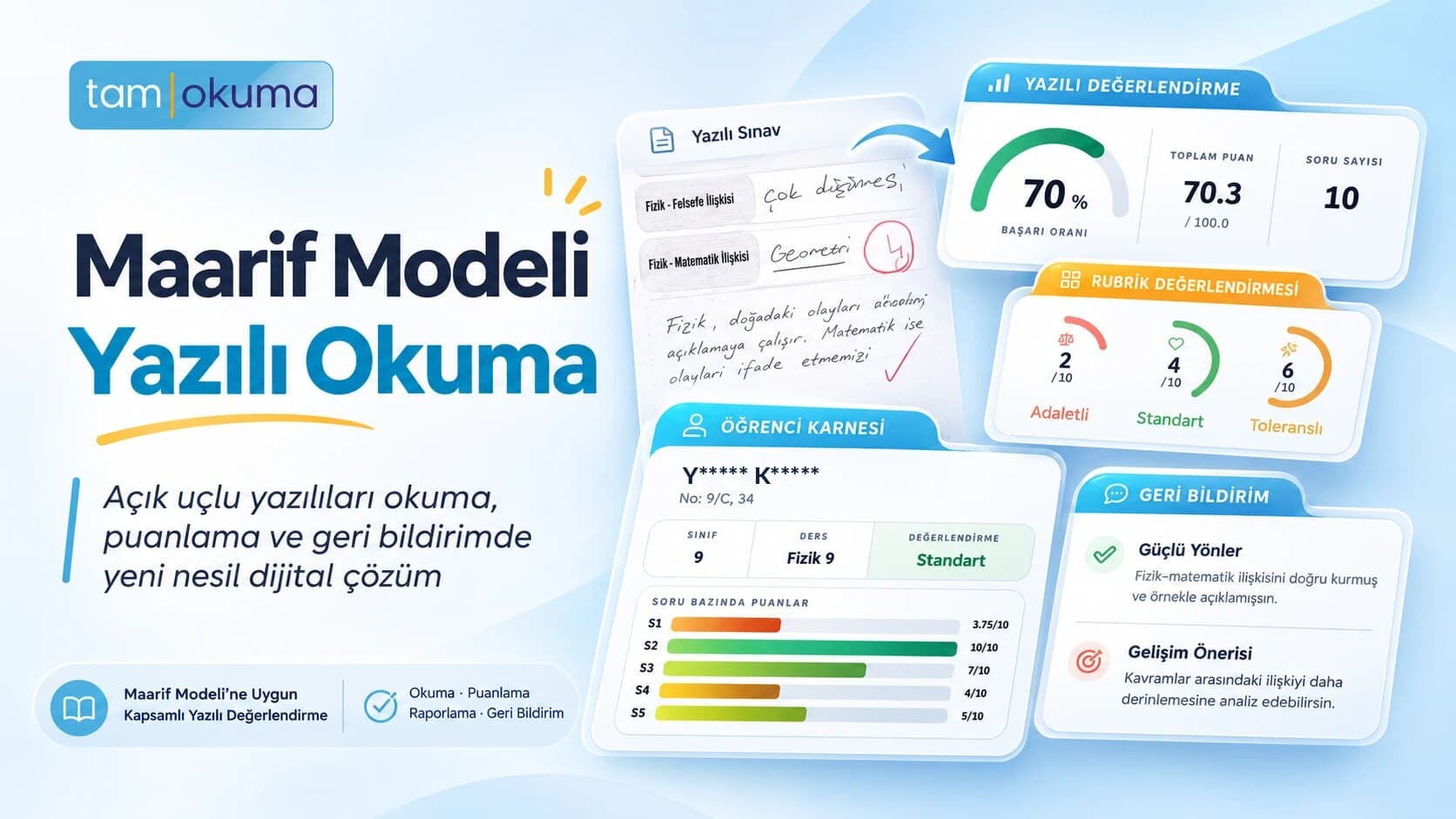
Picture a question with three criteria: defining the concept correctly, providing a justification and supporting it with an example. The OCR engine converts the handwriting into digital text, and rubric-scaled scoring examines each answer against the criteria you defined. The output is a partial-score breakdown for every criterion plus a draft of reasoned feedback. Which criterion earned full credit and which earned partial credit is shown separately on screen.
4. Teacher Review, Score Approval and the Reasoned Feedback Report
The final word is yours. The proposed scores arrive on your screen; you approve the ones you agree with and correct the ones you do not. Once you approve, the system produces the reasoned feedback explaining why an answer received that score, together with the analysis reports.
TamOkuma for Teachers, Schools, Courses and Publishers
According to the plan reflected in the 2027 Presidential Annual Programme, MEB aims to apply school-based monitoring in Turkish, mathematics and science in middle and high schools, and to use AI in scoring open-ended answers. Press reports indicate the rollout will be phased; for the exact timetable it is worth following MEB's official announcements.
For private schools and courses that want to mark and report their own exams in line with this approach, TamOkuma offers a ready-made infrastructure. What students gain is seeing the reasoning behind a score: a student who knows which criterion cost them marks, and why, finds it easier to see what to study.
According to IndiviTech's own institutional figures, the ecosystem reaches more than 1,000 schools and over 100,000 active teachers, and analysis work is carried out for more than 150 publishers.
What Kind of Analysis Report Does TamOkuma Provide to Schools, Courses and Publishers?
It is not only about calculating a total score. TamOkuma turns results into learning outcome reports at four levels:
- Student: Gaps by learning objective, with reasoned scores
- Class and section: Differences between sections and shared gaps
- Learning outcome: The outcomes students collectively struggle with
- Institution: An overall view that grounds teaching plans in data
For institutions that run common exams, this picture provides a solid basis for publisher and private school exam analysis.
End-to-End Integration with indiviSchool, indiviStudio and indiviBook
IndiviTech brings its four core products together on a single data layer and curriculum map. Questions can be prepared with AI support in indiviStudio, which is aligned with both the Maarif Model and the IB DP; content is delivered through the digital book platform indiviBook. TamOkuma reads the papers and indiviSchool runs school management. Because the products share the same data layer, the process runs on one infrastructure from question creation all the way to the report card.
Speed and Teacher Control Together in Maarif Model Written Exam Marking
The 2023 regulation and the Türkiye Yüzyılı Maarif Modeli that followed it have made open-ended exams and rubric-based assessment ordinary practice in middle and high schools. The question is no longer whether to run open-ended exams, but how to mark hundreds of answers consistently. TamOkuma aims to lighten that load with OCR and teacher-approved AI scoring, giving students reasoned feedback and institutions reports by learning outcome.
To see Maarif Model written exam marking on your own exams, visit TamOkuma's project website and request a demo. We suggest bringing a few sample papers from a recent exam along with the rubric you use.
Want to learn more?
Get in touch with us to explore how IndiviTech can transform your education experience.
Contact us